Tuesday, 16 September 2014

Kyran's Adventures in Milan

Milan, Italy and the European Embedded Design in Education and Research Conference 2014

A strictly "Kyran" Blog experience!


This blog is brought to you directly and exclusively by me, Ky ran! I will be vaguely talking about my adventures in Milan, Italy, in my usual wishy-washy way. I went alone, and the following is my story! Behold!

I first give my thanks to David Morales and Prof. Vinod Chandran for the opportunity to be involved with the technical paper which lead me to go to Italy in the first place, to attend this interesting conference in their stead.

I left Madrid on the plane on Wednesday afternoon, September 10, full of dread with limited phone battery and lack of Italian speakingz skillz. There are basically zero photos of my trip to Italy due to this issue, however I have one thing to say - Italians are crazy drivers! I had with me a huge tube with the A0 size poster rolled up in it (which was difficult to get printed in Spain!).

I landed at the Malpensa airport in Milan (one of three, I believe) and took the express train to the city - it was about 9pm at this time, and I was not in the mood for hours of transit by train and bus to the hotel which google forewarned me about. I took a taxi. Thus my "Italians are crazy drivers" comment earlier was my experience from this haha.


My hotel was a dodgy 2-star place called Hotel Bristol. It was about 2km from the conference venue. Below are some pictures from the 4th floor (damn stairs!!). It was pleasant weather, and two of the nights I was there were rainy, even with a bit of lightning far off to the north. The breakfast at the hotel was disgusting - these weird pre-packaged croissants with either jam or chocolate in the middle... and crackers - yep that's it!!! So unhealthy it's not funny.

Random streets in Italy - all nice and green.


This is my random selfie[s] while walking to the conference venue - a gentle breeze and lots of leaves falling off the trees. Was a nice walk, and not too hot!


Cosmo Hotel Palace

There it is! The walk was not too long at all! And thankfully on the first day, I did not need to take my ungainly giant poster container.  The photos directly below to the left and right are from the bar (yeah, totally went straight to the bar!) and show parts of the lobby of the Cosmo Hotel Palace (CHP).
 The hotel itself was nice I guess, the staff were friendly enough and there was a never-ended supply of croissants and fruit juice! The next few pics are just some random pictures taken from demonstrations and posters that I saw as I mingled and attended the presentations which ran in multiple sessions in multiple rooms through the two days of the conference.
The pic with the red table to the left is some form of image processing demo. Below that is another image processing demo where the processor finds the outlines of things (fast gradient change) and does some filtering and blurring, and then adds the outline layer back in to give supposedly better vision for people who are going blind due to macular degeneration.


Toys as tools! This poster describes a design-and-build challenge for uni students to build a mobile vehicle robot thingy, and do some basic challenges. They get bonus marks for creativity!


The poster room is like a giant dungeon, below all the lecture halls for the oral presentations. Here is where the afternoon tea and biscuits are served too. It's all so civil! Imagine that right now, people in Iraq are being slaughtered by ISIS solders.. such a shame.


More robots! This is the Yrobot platform, with a new top piece called "AudioCom" where the robots ACTUALLY TALK TO EACHOTHER!!! In an audible fashion. There has been research done on this kind of thing before, in fact [one of] my ex-supervisor's partner Ruth Schultz did some work at UQ on this topic, a news article is here for those interested in audio-communication for robots.

This is the accompanying poster...


Demon Toilet Of Doom + 3


I call this the demon toilet, because it's alive, and evil. Oh and it's obviously magical, so that's the +3 modifier [D&D joke..]. The evil red eye above where the "button" is. The "button" by the way is locked, and you must suffer the demon toilet's strange behaviour. First, when it spots you entering the toilet cubicle, it immediately begins it's watery laughter. A constant, never-ending stream. As long as you are in the damn cubicle. 

The worst part is while you are sitting on it, it's splashing you, laughing with it's beady little infrared eyeball. If you lean forward or whatnot, it assumes you are done and DOES A FULL FLUSH! NOOO! This is the most inconvenient robot demon toilet i've ever encountered.  I had many battles with this bastard thing during the conference unfortunately.


Here is the poster! On the friday morning I took the poster tube with me on my walk to the conference.


Was a few people who were into the same interests/field as this electric brushless DC motor drive paper. The inventor of instaSPIN was there, doing tutorials on the system that he designed in collaboration with Texas Instruments. There was at least one other poster and one oral presentation on the same general topic, as well as researchers in general who were involved heavily in this field. Overall there was a positive response to the work done and shown in the poster! The few more interesting questions I dutifuly forwarded on to David as they may help him in future work. Below is a picture of me with the poster!


On the first night, they held the banquet. I got invaded by multiple offers of meat-like substances, and it took them a while to work out what vegetarian meant. Below is a picture of some of the hand-shaking-and-award-presenting that occurred. You can see Prof. John Soraghan from the Scottish University of Strathclyde and the Texas Instruments global marketing manager dude (I am sure his first name is Steve, I shook his hand etc at the bar.. whoops). 


On the last day, I went out on the streets and stumbled upon a genuine street market! There was lots of cheap random stuff for sale, I walked around the stalls a lot but didn't actually buy anything. I killed some time and went back to the hotel and checked out, ready for my long and arduous (turned out to be almost 7-8 hours in total) adventure back to Madrid, back to my lonely wife!


First I checked the metro map in the hotel, it showed me where to go - turns out this map is super out-dated but it still worked, the general direction was the same :).
Terrible lighting conditions in the subway! Even Spain has a better lighting in their tunnels.
Not sure about Italian plumbing, you'll have to ask the Mario Brothers for that. This, however, is SHIT electrical wiring! That is how they powered the tap "ON" sensors in the airport departure gate lounge area!

And to finish it all off, the usual hilarious shitfight at the boarding gates trying even just to get out to the plane, let alone get into it.


In summary, I had a great time, met lots of great people, and got some free stuff (Beaglebone Black, weird wireless sensor tab thingo, and a Piccolo C2000 dev board) too.

I think conferences like these are good for networking, and it's possible that I have a lead for my next move - TO GERMANY! Otherwise, TO CANADA! or... TO ANY OTHER PLACE IN EUROPE!! WOO!

Thanks for reading if you got this far, you need a medal or something. Have a weird picture or two for good measure.

John Rambo Approves the above message


Tuesday, 9 September 2014

Avila, Segovia and a little around Madrid


Hello and welcome to the next installment of Traveling with the Findlaters. 
In this episode we visit Avila for a medieval market festival and then onto Segovia to see one if its famous landmarks.
Towards the end of the adventure we headed into Madrid to celebrate my aunty's birthday and finished it off with a cycle down the river side.
***


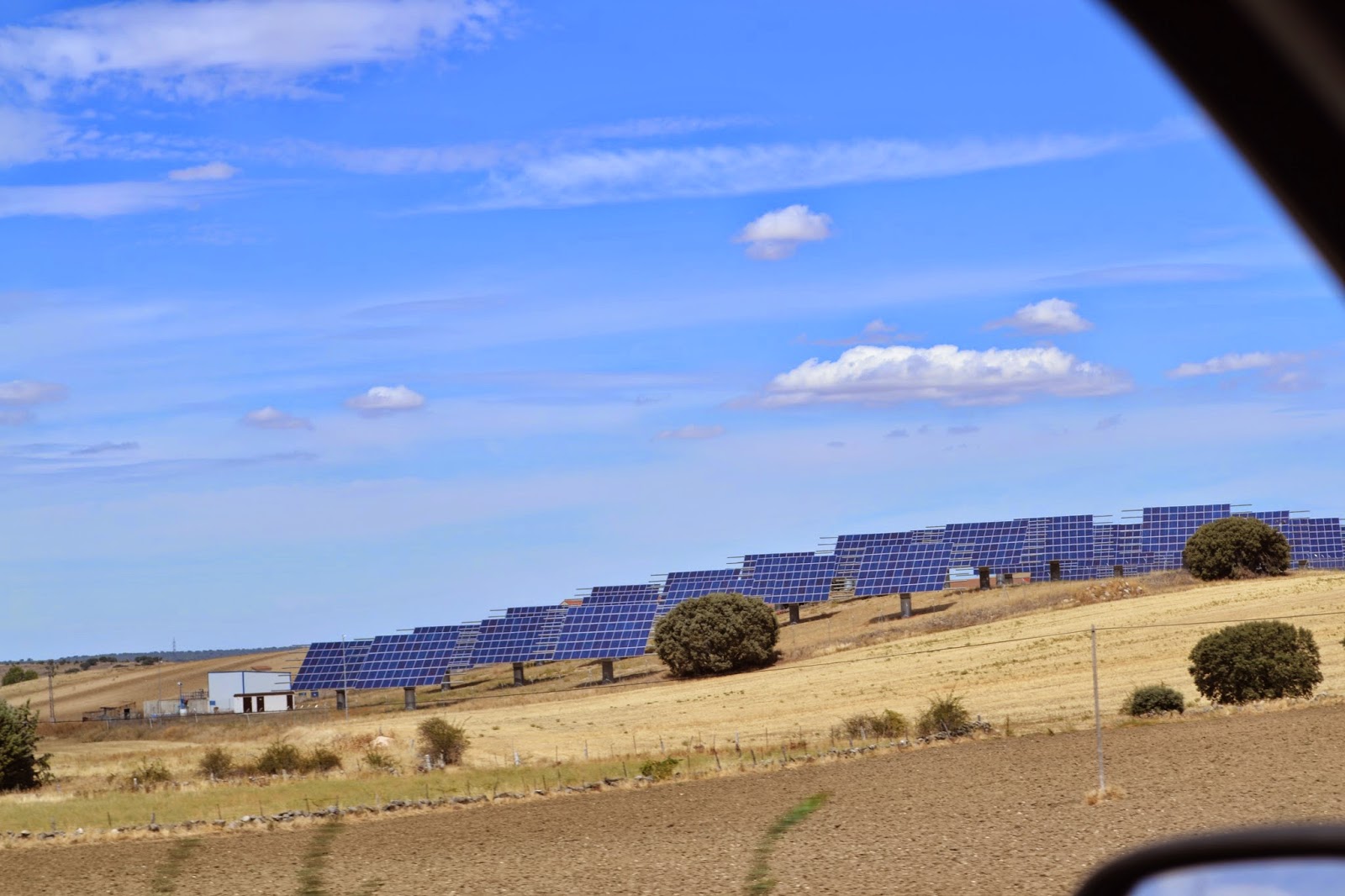
But first a comment: The image above and to the right are of the giant wind turbines that seem to cover the ridges of the hills and mountains throughout the inner road areas of Spain.                                                                                                                               The image to the bottom right  are of what appears to be a solar farm in the unused farmlands of inner Spain.                                                                                                        Overall 23% of Spain's electricity was generated from wind and solar in 2010.                                                                 Spain has set the target of generating 92% of its energy needs from renewable energy sources.                                                                                                                         Spain is the world's third biggest producer of wind power, after the United States and Germany, with an installed capacity of 20,661
.

First up Avila.
 
Avila is notable for having complete and prominent medieval town walls, built in the Romanesque style.  

It is sometimes called the Town of Stones and Saints, and it claims that it is one of the towns with the highest number of Romanesque and Gothic churches (and bars and restaurants) per capita in Spain. 

Below are a series of photographs of birds that were on display for the Medieval Market. What start off as being a novel thing (despite my disagreements on the topic of caged or restrained animals) soon turned into something of an animal well fair issue as completely nocturnal birds were tied to posts in full sunlight in the middle of the day. 


I obviously kicked up a stink to anyone who would listen and could help the birds,
Kyran dragged me away before anything could escalate further. 
Needless to say i was not impressed. 

But moving on! 


 Tickets to climb the wall that surrounds Avila were 5 euros each and as we were limited by time this seemed like a good way to get a good scope of Avila while learning it's history and see its views.

The walls of Avila
 
The work was started in 1090 but most of the walls appear to have been rebuilt in the 12th century. 

The enclosed area is an irregular rectangle of 31 hectares with a perimeter of some 2,516 meters, including 88 semicircular towers. 

The walls have an average breadth of 3 metres and an average height of 12 metres. 

The nine gates were completed over several different periods.


These fortifications are the most complete in Spain.


Some of the sights around Avila


To the right: a medieval obstical  course for children that can be seen in the back ground dressed as horses. 


SEGOVIA


Segovia was first recorded as a Celtic possession, with control eventually transferring into the hands of the Romans.

During the Roman period the settlement belonged to one of numerous contemporary Latin convents. It is believed that the city was abandoned after the Islamic invasion 
of Spain centuries later.

Segovia's position on trading routes made it an important center of trade in wool and textiles.

The end of the Middle Ages saw something of a golden age for Segovia, with a growing Jewish population and the creation of a foundation for a powerful cloth industry.  
In 1764, the Royal School of Artillery, the first military academy in Spain, was opened.  

In 1985 the old city of Segovia and its Aqueduct were declared World Heritage by UNESCO 


The Aqueduct of Segovia (or more precisely, the aqueduct bridge) is a Roman aqueduct and one of the most significant and best-preserved ancient monuments left on the Iberian Peninsula. 

The actual date of the Aqueduct's construction has always been considered a mystery although it was thought to have been during the 1st century AD,


The aqueduct transports water from Fuente Fría river, situated in the nearby mountains, some 17 km (11 mi) from the city in a region known as La Acebeda. It runs another 15 km (9.3 mi) before arriving in the city.

The water is first gathered in a tank known as El Caserón (or Big House), and is then led through a channel to a second tower known as the Casa de Aguas (or Waterhouse). There it is naturally decanted and sand settles out before the water continues its route.

At its tallest, the aqueduct reaches a height of 28.5 m (93 ft 6 in), including nearly 6 m (19 ft 8 in) of foundation. There are both single and double arches supported by pillars. From the point the aqueduct enters the city until it reaches Plaza de Díaz Sanz, it includes 75 single arches and 44 double arches (or 88 arches when counted individually), followed by four single arches, totalling 167 arches in all.

The construction of the aqueduct follows the principles laid out by Vitruvius as he describes in his De Architectura published in the mid-first century.


As the photo suggests we also visited the cathedral of Segovia.

It is located in the main square of the city, the Plaza Mayor, and is dedicated to the Virgin Mary. 

 The Cathedral of Segovia is one of last Gothic cathedrals built in Spain and Europe. It was built in the mid-sixteenth century, when in most of Europe, Renaissance architecture it was the new reference.


 Left: What happens when choir boys eat to much


Below: Some final images from Segovia


Birthday celebrations took us into Madrid on Sunday and ended with a crazy fun filled ride along the banks of the highly regarded Rio Manzanares. below are the resulting photos
.


That brings us to the end of another episode, sorry it was a bit rushed but I hope you get the idea. 

The next Blog will be brought to you by Kyran from Milan (Sorry if it's a bit too nerdy!)

***

Just a quick shout out to my Nan who I hear is the next biggest fan of this blog!